I traveled to and from Las Vegas from the Burbank, CA airport to visit my daughter's family and my grandsons this past Father’s Day. I had a great time there enjoying a cabana at the J.W. Marriott in Summerlin and the "Greatest Show on Earth" at the UNLV stadium.
However, air travel security is a joke. Las Vegas has the new X-ray scanners, and I got to experience that. I was told to remove my wallet and hold it in my hand and raise my arms above my head. Fine. While I hate the intrusive searches just to take a plane, it was better than driving 5 hours, as long as there were no traffic problems.
When I got out of the X-ray machine the TSA person went through every compartment of my wallet. What the heck can I use from my wallet to take down a plane? This seems so ridiculous.
However, I see the complete joke of security when Olajide Oluwaseun Noibi can travel all over the United States with only a college student ID and other people’s expired boarding passes. I become even more enraged when I see on the Internet as a sweet little 6-year-old girl is frisked, and as a baby is given a pat-down while being held stomach-down by its mother. And then there is the crying young woman who said the intrusive body search she had to endure in Dallas made her feel violated. Of course it did.
You don’t see the airport screeners for Israel airlines going through people’s diapers. This happened to 95 year old Lena Reppert who suffers from leukemia and has to wear an adult diaper in her wheelchair. For Israel the screeners are well trained and interview people who they might suspect. They know what to look for and have the best airline security in the world. Meanwhile we have TSA staff that are needlessly thorough instead of smart and leave us neither free nor safe, just annoyed. I think next time I will drive to Las Vegas or take a bus.
Rennie
Friday, July 1, 2011


Sunday, November 7, 2010
China trip summary
 Many folks have commented they loved the humor in Part 1 and Part 2 of the China trip, however, it was just too long. So I have created a summary. Obviously, if you want the details, you can scroll down and read the whole story. I have received great comments, like "very funny," "hysterical," and "really got a kick out of it" on my cartoon video: "Rennie does not want to go to China." But you have to click on the link to see it:http://www.xtranormal.com/watch/7442923/
Day 1 in Shanghai: Lot's of tall new buildings. Arrived at the hotel and cab driver left with our luggage. Wanted us to pay the meter fare when he came back. We got our luggage and laughed at him.
Day 2 in Shanghai: Went to the Jewish Museum and the 2010 Expo. If you don't like someone, send them to the Expo. Drivers here are crazy. Traffic lights, lanes, one way streets, cross walks, and sidewalks are only suggestions. As a pedestrian, on a one way street or sidewalk you can be hit from any direction at night by electric scooters none of which use their headlights.
Day 3 in Shanghai: Tour started. Went to Shanghai Museum and silk carpet factory. Didn't buy anything.
Day 4: Took bus to Suzhou, pronounced Sue Joe. Went to the Master-of-the-Fishing-Nets-Garden-Home-and-Tourist-Destination. Dianne bought silk paintings.
Next was a silk spinning factory. Dianne bought silk scarves.
Day 5: Got on the riverboat for a 4 day trip on the Yangtze River.
Day 6: First stop, The Three Gorges Dam. Amazing structure and potential ecological disaster. No one drinks the tap water in China, not even the Chinese.
Day 7: We took an excursion up the Shennong Stream. Dianne purchased porcelain shoes.
Day 8: Shore excursion to the Ghost City of Fengdu. Saw a wonderful example of a Chinglish sign: "Beacuse (sic) being under constrction (sic) cause inconvenience to you, invite respectively forgiving." Dianne bought a wooden face mask.
Day 9: Arrived in Chongqing (pronounced Chung King) Saw the pandas. Wow! They are like big cuddly koala bears on drugs. Dianne bought an umbrella.
Day 10: Arrived in Guilin and took a ride on the Li River. I bought post cards. Dianne bought four wood carvings, an old watch, vase, bracelet, other stuff, a partridge in a pear tree, and a suitcase to hold it all. We learned how to get ripped off by the vendors even when you negotiate the prices.
Day 11: Arrived in Xi'an. (pronounced She Ann) Visited a tea plantation. Dianne bought a tea strainer and Osmanthas tea. Dianne bought all sorts of things like Tiger Balm and silk gift bags.
Day 12: Walked on the ancient city wall of Xi'an and visited the Big Wild Goose Pagoda. I purchased a jade chop. (You will have to ask me what that is.)
Day 13: Saw the Terra Cotta Warriors. Very exciting. I bought a book and Dianne bought miniature Warrior figures.
Day 14: Beijing: Went to Tiananmen Square and the Forbidden City. Nothing to buy.
Day 15: Went to the Temple of Heaven, the Great Wall and a cloisonne factory. I purchased a collapsible walking stick and Dianne bought cloisonne jewelry.
Day 16: Visited the Summer Palace and a pearl factory. Dianne bought two pearl necklaces. Most of what Dianne purchased were for gifts, and if didn't say that I would be in a lot of pain. Tell her you think this was funny. PLEASE!
Day 17: From Beijing left for home, Whoopee.
Sunday, October 24, 2010
China Part 2
China Part 2
After I got home I made a 1 ½ minute cartoon movie about my resistance to go to China. You can see it at http://www.xtranormal.com/watch/7442923/
Wednesday Oct 13, 2010
While much of the additional information for the places we visited is from the website for the Travel China Guide Tour company, Dianne and I went with China Plus Tours due to it’s small group size limits. You can find out more about China Plus at http://www.ChinaPlusTours.com toll free: 888-868-8811
Our first tour today is a boat ride on the Lijiang River from Zhujiang Wharf to Yangshuo County in Guang Xi Provence. I thought it would be a 3 to 3.5 hour cruise, but it turned out to be 4.5 hours. While the scenery was beautiful, it was just too long for me. Lunch was served on board and at our last port I learned how the merchants can fleece the tourists, even after bargaining. Dianne found a stall that had some carved wood shutters (see photo), that she had been looking for. Plus she found a vase, figurines, jewelry, etc.

Dianne bargains hard. He started out at something like 3400 Yaun ($503 US) she got it down to 1600 Yuan (about $260).After she paid, he said he had more things she might like upstairs, and while upstairs his wife would wrap our purchases.
You guessed it, not everything she paid for was put in the bag and Dianne had more items she purchased from upstairs. Dianne got so much stuff I went to another stall and bought a suitcase to put it in so we could get it all home. The suitcase was $38, but I negotiated it down to $25. Obviously I am not as good at bargaining as Dianne. Anyway, we now have three suitcases for the rest of the trip.
 We drove back on the bus to Guilin and visited the Guilin Tea Science and Research Institute. It is the key tea institute of Guangxi founded in 1965. The whole plantation contains about 40 hectares, and owns 250 different tea plants. We learned how the same bush can provide 4 types of tea; white, green, oolong, and black depending on which leaves are harvested. We participated in a tea ceremony and tasted all 4 types. Dianne and I have prepared tea all wrong our whole life. We then went to the gift shop and purchased a tea strainer. Remember how the factories work: Show you how it’s made and then ask you to buy. You can read more about this plantation at http://www.guilintea.com/cby/help.asp?action=about
Thursday Oct 14
Plane travel was relatively easy throughout China except right now. I always carry a single blade pocket knife to cut boxes, open packages & envelopes, cut fruit, and whatever. I know what you’re thinking: NO, I did not have it on me or in my carry-on case. I packed in my suitcase that got checked in. Well, I was called back behind the scenes because they saw the knife in the suitcase and wanted to confiscate it. It didn’t matter that it was in the baggage that was checked in for the cargo hold. They didn’t want me to have that knife anywhere in China. I negotiated with 5 employees before giving up. I guess they want to be sure that no one in China is armed in any way except for police and soldiers. Remember, this is a communist country.
We flew to Jason's home town of Xi An, pronounced "she an." I still cannot figure out how these English letters make those different sounds. Xian is the center of Chinese history due to 11 dynasties being in this area for more than 3000 years: From Zhou to the Han, Jin, Tang, and Qing dynasties including the ancient city wall and the terracotta warriors.

The population of the city is about 3.5 million with another 4.5 million in the surrounding area. It is too small to be its own governing area, but it is the capital of its province. We started our tour with a visit to the small Wild Goose pagoda and park.
We then went to the Shaanxi Museum. Read about the museum at http://www.chinamuseums.com/sx_history.htm
Friday October 15, 2010
In Xi’an our hotel was the Golden Flower:
http://www.shangri-la.com/en/property/xian/goldenflower It was the first joint venture hotel built in China and was exclusive to foreigners. It was done by the Shangra La hotel company in 1983.
1. Our first stop today was a visit to a jade factory with the typical demonstration of what it takes to go from a rock to amazing jewelry and sculptures. In Chinese, jade is pronounced as 'Yu', and most words related to moral include this word such as 'Unpolished jade never shines,' indicating that one cannot be a useful person if he is not educated. Jade also implied honor and conviction. Many girls in ancient times were also named with jade to reflect the love of their parents. One of the Four Beauties in Chinese history, Yang Yuhuan, the beloved concubine of Emperor Xuanzong in the Tang Dynasty (618 - 907), was their representative. Yang is her surname and her given name Yuhuan means simply 'jade ring'. You can read more about jade from Xi’an here: http://www.travelchinaguide.com/intro/arts/jade.htm. All of the pagodas, temples, and factories have gift shops. I don't know if you can call a 6-12,000 facility a "shop." Perhaps gift warehouse would be more appropriate. We then went to the warehouse sized showroom with sales clerks and bought some jade.
2. Our next stop was the large Wild Goose pagoda.http://www.travelchinaguide.com/attraction/shaanxi/xian/bigwildgoose.htm All the temples and pagodas have appropriate sized gift shops instead of the warehouse sized shops like the factories. After all they were built hundreds of years ago. Anyway, at the Wild Goose Pagoda this was only about 2000 square feet so you could call it a gift shop instead of a warehouse, and I purchased a jade "chop" there. This is what people would use to stamp their name.
If you miss a gift shop anywhere in China at a tourist stop, there are plenty of street vendors selling items like postcards, umbrella hats, and steamed corn to books and fake Rolex watches. I know they were fake because they called them “Lolex” watches. The typical sales pitch goes like this: “Post cawds, one dolla. You want? One dolla, one dolla. Here! One dolla, one dolla. Look, one dolla.”
3. Our third stop of the day was the Xian Shaanxi History Museum tracing the history of China from the stone age through the Zhou (pronounced as "Joe") starting around 2100 BC - 771 BC and the Qin Dynasty 770 - 207 BC, and Han dynasty (pronounced “Hun”) 206 BC - 220 AD. I thought it was amazing they could be so precise with dates 4000 years ago, but that's how strong their recorded language was. To learn more about this museum go to http://www.travelchinaguide.com/attraction/shaanxi/xian/provincial_museum/
4. Our next stop was the ancient city wall. It is one of the few city walls still standing and continues to be protected and repaired. You can rent a bike and peddle around the top of the wall in about an hour. When Zhu Yuanzhang, the first Emperor of the Ming Dynasty (1368-1644), captured Huizhou, a hermit named Zhu Sheng admonished him that he should 'built high walls, store abundant food supplies and take time to be an Emperor,' so that he could fortify the city and unify the other states. After the establishment of the Ming dynasty, Zhu Yuanzhang followed his advice and began to enlarge the wall built initially during the old Tang dynasty (618 -907), creating the modern Xian City Wall. It's the most complete city wall that has survived in China, as well being one of the largest ancient military defensive systems in the world. Read more at http://www.travelchinaguide.com/attraction/shaanxi/xian/citywall.htm
5. Our final event of the day was a spectacular dinner and colorful show. The Tang Dynasty is regarded as the most progressive and prosperous era in the days of Imperial China and its music and dance symbolize the glory and splendor of Chinese civilization. Read more at http://www.chinaspringtour.com/guide/item.jsp?id=579
I think I forgot to mention the daily big breakfast each of the hotels provided; then a huge lunch at a free standing or factory restaurant; and the large dinner portions served on a lazy Susan. We never finished all the food that was prepared for our group. I thought I’d gain 5 pounds before I got home, but it turns out I got back home at the same weight as I when I left.
Saturday, October 16
 Big day - Today we visited the Terra Cotta Warriors built by the first emperor of China, Qin Shihuang around 1400 AD. It took about 38 years to build this tomb using 700 - 800,000 slaves. And there were more slaves used to connect the various parts of the Great Wall. In addition to connecting the various city walls to create the Great Wall he standardized the language to small seal characters; standardized the legal codes, and the currency. The man knew how to get things done. Other than all the people he enslaved, burning the books of the past history (except for those on agriculture or superstition); burying alive 460 Confucius scholars; he was a rather progressive and results oriented Emperor.
After Qin Shihuang died and his dynasty was overthrown, the following ruler of the area broke into the tomb and did his best to break and burn as much as he could. So nothing was recorded in the Chinese historical books about the tomb or the location.
The warriors and horses were discovered by accident. On March 29, 1974, five farmers were digging a water well when they broke into a hole and ended up pulling out a terra cotta head. Within one month the news spread to the top level of the communist government and the area became protected by the State Cultural Relics Administration. This was a cover story in a 1978 issue of National Geographic. Two of the farmers are still living and one of them signs books at the Museum to earn his living. To learn more about this amazing site visit http://www.terracottawarriorexhibit.com
We flew out that evening from Xian to Beijing, the capital of China and arrived at 7 pm.
Beijing has a population of 18 million, which is about half the population of the entire state of California and larger than the population of Hartington, Nebraska and Sioux City, Iowa combined. Actually that’s about 4 times larger than the state’s population of Nebraska and Iowa combined. Anyway, it’s a big place and we stay here for 4 days.
Sunday, October 17
Countdown: Only three more days before I get to go home.
Our first stop today is Tiamanmen Square. It’s a rather large area that could hold 1 million people before Mao Tse-Tung’s (or Mao Zedong ) mausoleum was built in the 1970s. The square has several building in it and on one end is the Forbidden City. The crowds here were overwhelming with a 6 hour wait in line to see Mr. Mao lying in state. He was much like Emperor Qin, only he didn’t kill the intellectuals, just “re-educated” them in prisons or on farms.
Jason’s grandfather got to live on a farm for 15 years, in a horse stall with the donkeys, for his re-education. Jason’s mom, who was a doctor before the cultural revolution, got to wear a dunce hat and occasionally stand in the square to get berated by soldiers and workers. A notice was posted on their door that they had family members who were counter revolutionaries. Jason was only 7 years old at the time. Needless to say, Mao was not popular with people who had an education.
The weather in Beijing is colder than in the south were we started in Shanghai. The Royal Palace, which is now called The Forbidden City, was built over 14 years starting in 1406 AD and is twice the size of Tiamanmen Square. The buildings are all wood and burnt down about 5 times from lightening strikes. The last time it was rebuilt was about 200 years ago and it was remodeled about 3 ½ years ago just before the Olympic games. The last Emperor lasted from 1907 to 1911, and when the royal family lived there the family had about 200 people. That probably did not include the 100-150 concubines. The total population of the Forbidden City was about 2000 people, which did include the servants. Although there were more than a few concubines for the Emperors over the 500 year time span, each Emperor only had two wives.
Later that day we saw the ordinary side of Beijing. Many of the small streets have names like Xiuan Hutong. Hutong is a Mongolian word that mean “where people live.” Mongolia conquered China around 1300, but only had Beijing as the capital for 100 years. The Mongolians were then conquered by the Ming Dynasty who established the Royal Palace (Forbidden City). In one of the Hutong’s we got to visit a private home.
The home we visited had three rooms on one side, a courtyard in the center, and a kitchen and one room on the other side. Each room was about 10’x10’. Oh, there was NO bathroom; they had to use the public bathroom and shower about 150 feet down the street. That must make it fun in the winter if you have an upset stomach. And I forgot to mention that sewage is a problem in Beijing. I already told you the Chinese cannot drink their own tap water.
Monday, October 18, 2010
Only two more days until we go home - Yipee
We started the tour a half hour earlier today (8:30) to get a head start on the Monday morning traffic. With 4.5 million cars and 10 million bikes, and 1000 cars per month being added to the streets, the traffic is worse than the Ventura Freeway at rush hour. And remember, street lights and traffic lanes are merely suggestions.

When we arrived at the cloisonné factory I was startled to learn how many steps were involved in making this beautiful stuff. It’s a 7 step process and most of it is done by hand. It starts with copper wire on an object like a plate or vase; an eye dropper is used to drip paint into the copper separated areas; it dries in the air for a couple of hours; it then gets fired in a special kiln; then more color, more firing, polishing, etc. The prices ranged from 80 yuan ($12) to 1,200,000 yuan ($177,000). Again, everything is negotiable and Dianne bought stuff. Find out more at http://www.china-cloisonne.com/aboutus/index.asp
This factory, like many others we visited, is owned by the government. It was built on land previously used by farmers who are compensated for giving up the land. They are also given the choice of becoming a worker in the factory or finding other work in the city.
Monday continued:
Next stop; the Great Wall of China Since most of our group are in their 70s and 80s it was decided that we would not walk all 5,500 miles of the wall. Besides, many parts of it are missing since the construction began 500 years before Christ was born. So we voted to go to the most famous and most visited part of the wall near Beijing; the Ba Da Ling portion.
I found parts of the wall to be very steep to walk up, just like walking up the steep hills and mountains that it was built along. Tourists from all over the world, but mostly Chinese were walking everywhere and taking photos. I took photos of couples so they could both be in the picture, and they would take photos of me.

It would have been nice if I had a photo of me and Dianne together on the wall, but Dianne walked in the opposite direction when she got up to the wall. I had to take a bathroom break before going up there, and Dianne didn’t wait for me. The guide suggested we turn left when we walk up to the wall because it will be less crowded, so Dianne went to the right. I didn’t see her again until I got back to the ticket area. Anyway, everyone was really great about taking photos for other people. And when you get high enough on the wall the views are spectacular. After all, you are on the top of a mountain. To read about this part of the great wall go to http://www.travelchinaguide.com/china_great_wall/scene/beijing/badaling.htm. To read general information about the Great Wall from Wikipedia click on this link: http://en.wikipedia.org/wiki/Great_Wall_of_China
We really lucked out too because just as we were getting back on the tour bus it started to rain. If we were up on the wall we would not have been able to see much at all nor take any photos. I purchased a collapsible walking stick from a vendor for $7.50 (50 Yuan)

Our last stop on this day was the Temple of Heaven. It was the only round temple we saw. Kind of looked like the Capitol Records building, only older. It is a Taoist temple where the people would go to pray for a good harvest. To read about this temple go to http://en.wikipedia.org/wiki/Temple_of_Heaven
Tuesday, October 19
Countdown, last day before I get to go home.
Today we headed out to the Summer Palace. This is where the Emperor would go after a winter in the Forbidden Palace. It had a man made pond that looked like the size of Lake Erie. We rode from one end to the other on a boat shaped like a dragon. To see a photo and learn more about the Summer Palace go to http://en.wikipedia.org/wiki/Summer_Palace

On the lake there is a Marble Boat. Of course it can’t float, but it looks pretty cool.
Dianne purchased a funny set of glasses with an attached nose and mustache that expands out to the sides when you blow on the mouthpiece.
Next on the agenda for the day was a visit to the New City Pearl Factory.

Like many of the other factories, this is where we had lunch; got the demonstration, and allowed to buy the product. News: Pearls can come in different colors depending on the minerals in the water that the clams are living in. This way they can manufacture real black pearls. There are fresh water and salt water pearls. The photo of the open fresh water clam is about 5-6 years old and has 34 pearls it was working on. Dianne purchased pearl necklaces and a great face cream made from ground pearls.
We got back to the hotel by 3:30 and walked about 20 minutes to the 100 year old Beijing Hotel. It had artifacts in glass cases in the lobby and was a beautiful Raffels run hotel. Even the fragrance in the lobby was beautiful. We found out they use a smell machine to produce the aroma in the lobby.
Now it is time to pack up for the trip back to Los Angeles. We leave from the hotel Wednesday morning at 6:30 for our 10 am flight back home. After a layover and transfer in Hong Kong it will be about 18 hours of travel and we arrive in L.A. at 2:45 PM. The Resistant Traveler will be so glad to get home.
Rennie
After I got home I made a 1 ½ minute cartoon movie about my resistance to go to China. You can see it at http://www.xtranormal.com/watch/7442923/
Wednesday Oct 13, 2010
While much of the additional information for the places we visited is from the website for the Travel China Guide Tour company, Dianne and I went with China Plus Tours due to it’s small group size limits. You can find out more about China Plus at http://www.ChinaPlusTours.com toll free: 888-868-8811
Our first tour today is a boat ride on the Lijiang River from Zhujiang Wharf to Yangshuo County in Guang Xi Provence. I thought it would be a 3 to 3.5 hour cruise, but it turned out to be 4.5 hours. While the scenery was beautiful, it was just too long for me. Lunch was served on board and at our last port I learned how the merchants can fleece the tourists, even after bargaining. Dianne found a stall that had some carved wood shutters (see photo), that she had been looking for. Plus she found a vase, figurines, jewelry, etc.

Dianne bargains hard. He started out at something like 3400 Yaun ($503 US) she got it down to 1600 Yuan (about $260).After she paid, he said he had more things she might like upstairs, and while upstairs his wife would wrap our purchases.
You guessed it, not everything she paid for was put in the bag and Dianne had more items she purchased from upstairs. Dianne got so much stuff I went to another stall and bought a suitcase to put it in so we could get it all home. The suitcase was $38, but I negotiated it down to $25. Obviously I am not as good at bargaining as Dianne. Anyway, we now have three suitcases for the rest of the trip.
 We drove back on the bus to Guilin and visited the Guilin Tea Science and Research Institute. It is the key tea institute of Guangxi founded in 1965. The whole plantation contains about 40 hectares, and owns 250 different tea plants. We learned how the same bush can provide 4 types of tea; white, green, oolong, and black depending on which leaves are harvested. We participated in a tea ceremony and tasted all 4 types. Dianne and I have prepared tea all wrong our whole life. We then went to the gift shop and purchased a tea strainer. Remember how the factories work: Show you how it’s made and then ask you to buy. You can read more about this plantation at http://www.guilintea.com/cby/help.asp?action=about
Thursday Oct 14
Plane travel was relatively easy throughout China except right now. I always carry a single blade pocket knife to cut boxes, open packages & envelopes, cut fruit, and whatever. I know what you’re thinking: NO, I did not have it on me or in my carry-on case. I packed in my suitcase that got checked in. Well, I was called back behind the scenes because they saw the knife in the suitcase and wanted to confiscate it. It didn’t matter that it was in the baggage that was checked in for the cargo hold. They didn’t want me to have that knife anywhere in China. I negotiated with 5 employees before giving up. I guess they want to be sure that no one in China is armed in any way except for police and soldiers. Remember, this is a communist country.
We flew to Jason's home town of Xi An, pronounced "she an." I still cannot figure out how these English letters make those different sounds. Xian is the center of Chinese history due to 11 dynasties being in this area for more than 3000 years: From Zhou to the Han, Jin, Tang, and Qing dynasties including the ancient city wall and the terracotta warriors.

The population of the city is about 3.5 million with another 4.5 million in the surrounding area. It is too small to be its own governing area, but it is the capital of its province. We started our tour with a visit to the small Wild Goose pagoda and park.
We then went to the Shaanxi Museum. Read about the museum at http://www.chinamuseums.com/sx_history.htm
Friday October 15, 2010
In Xi’an our hotel was the Golden Flower:
http://www.shangri-la.com/en/property/xian/goldenflower It was the first joint venture hotel built in China and was exclusive to foreigners. It was done by the Shangra La hotel company in 1983.
1. Our first stop today was a visit to a jade factory with the typical demonstration of what it takes to go from a rock to amazing jewelry and sculptures. In Chinese, jade is pronounced as 'Yu', and most words related to moral include this word such as 'Unpolished jade never shines,' indicating that one cannot be a useful person if he is not educated. Jade also implied honor and conviction. Many girls in ancient times were also named with jade to reflect the love of their parents. One of the Four Beauties in Chinese history, Yang Yuhuan, the beloved concubine of Emperor Xuanzong in the Tang Dynasty (618 - 907), was their representative. Yang is her surname and her given name Yuhuan means simply 'jade ring'. You can read more about jade from Xi’an here: http://www.travelchinaguide.com/intro/arts/jade.htm. All of the pagodas, temples, and factories have gift shops. I don't know if you can call a 6-12,000 facility a "shop." Perhaps gift warehouse would be more appropriate. We then went to the warehouse sized showroom with sales clerks and bought some jade.
2. Our next stop was the large Wild Goose pagoda.http://www.travelchinaguide.com/attraction/shaanxi/xian/bigwildgoose.htm All the temples and pagodas have appropriate sized gift shops instead of the warehouse sized shops like the factories. After all they were built hundreds of years ago. Anyway, at the Wild Goose Pagoda this was only about 2000 square feet so you could call it a gift shop instead of a warehouse, and I purchased a jade "chop" there. This is what people would use to stamp their name.
If you miss a gift shop anywhere in China at a tourist stop, there are plenty of street vendors selling items like postcards, umbrella hats, and steamed corn to books and fake Rolex watches. I know they were fake because they called them “Lolex” watches. The typical sales pitch goes like this: “Post cawds, one dolla. You want? One dolla, one dolla. Here! One dolla, one dolla. Look, one dolla.”
3. Our third stop of the day was the Xian Shaanxi History Museum tracing the history of China from the stone age through the Zhou (pronounced as "Joe") starting around 2100 BC - 771 BC and the Qin Dynasty 770 - 207 BC, and Han dynasty (pronounced “Hun”) 206 BC - 220 AD. I thought it was amazing they could be so precise with dates 4000 years ago, but that's how strong their recorded language was. To learn more about this museum go to http://www.travelchinaguide.com/attraction/shaanxi/xian/provincial_museum/
4. Our next stop was the ancient city wall. It is one of the few city walls still standing and continues to be protected and repaired. You can rent a bike and peddle around the top of the wall in about an hour. When Zhu Yuanzhang, the first Emperor of the Ming Dynasty (1368-1644), captured Huizhou, a hermit named Zhu Sheng admonished him that he should 'built high walls, store abundant food supplies and take time to be an Emperor,' so that he could fortify the city and unify the other states. After the establishment of the Ming dynasty, Zhu Yuanzhang followed his advice and began to enlarge the wall built initially during the old Tang dynasty (618 -907), creating the modern Xian City Wall. It's the most complete city wall that has survived in China, as well being one of the largest ancient military defensive systems in the world. Read more at http://www.travelchinaguide.com/attraction/shaanxi/xian/citywall.htm
5. Our final event of the day was a spectacular dinner and colorful show. The Tang Dynasty is regarded as the most progressive and prosperous era in the days of Imperial China and its music and dance symbolize the glory and splendor of Chinese civilization. Read more at http://www.chinaspringtour.com/guide/item.jsp?id=579
I think I forgot to mention the daily big breakfast each of the hotels provided; then a huge lunch at a free standing or factory restaurant; and the large dinner portions served on a lazy Susan. We never finished all the food that was prepared for our group. I thought I’d gain 5 pounds before I got home, but it turns out I got back home at the same weight as I when I left.
Saturday, October 16
 Big day - Today we visited the Terra Cotta Warriors built by the first emperor of China, Qin Shihuang around 1400 AD. It took about 38 years to build this tomb using 700 - 800,000 slaves. And there were more slaves used to connect the various parts of the Great Wall. In addition to connecting the various city walls to create the Great Wall he standardized the language to small seal characters; standardized the legal codes, and the currency. The man knew how to get things done. Other than all the people he enslaved, burning the books of the past history (except for those on agriculture or superstition); burying alive 460 Confucius scholars; he was a rather progressive and results oriented Emperor.
After Qin Shihuang died and his dynasty was overthrown, the following ruler of the area broke into the tomb and did his best to break and burn as much as he could. So nothing was recorded in the Chinese historical books about the tomb or the location.
The warriors and horses were discovered by accident. On March 29, 1974, five farmers were digging a water well when they broke into a hole and ended up pulling out a terra cotta head. Within one month the news spread to the top level of the communist government and the area became protected by the State Cultural Relics Administration. This was a cover story in a 1978 issue of National Geographic. Two of the farmers are still living and one of them signs books at the Museum to earn his living. To learn more about this amazing site visit http://www.terracottawarriorexhibit.com
We flew out that evening from Xian to Beijing, the capital of China and arrived at 7 pm.
Beijing has a population of 18 million, which is about half the population of the entire state of California and larger than the population of Hartington, Nebraska and Sioux City, Iowa combined. Actually that’s about 4 times larger than the state’s population of Nebraska and Iowa combined. Anyway, it’s a big place and we stay here for 4 days.
Sunday, October 17
Countdown: Only three more days before I get to go home.
Our first stop today is Tiamanmen Square. It’s a rather large area that could hold 1 million people before Mao Tse-Tung’s (or Mao Zedong ) mausoleum was built in the 1970s. The square has several building in it and on one end is the Forbidden City. The crowds here were overwhelming with a 6 hour wait in line to see Mr. Mao lying in state. He was much like Emperor Qin, only he didn’t kill the intellectuals, just “re-educated” them in prisons or on farms.
Jason’s grandfather got to live on a farm for 15 years, in a horse stall with the donkeys, for his re-education. Jason’s mom, who was a doctor before the cultural revolution, got to wear a dunce hat and occasionally stand in the square to get berated by soldiers and workers. A notice was posted on their door that they had family members who were counter revolutionaries. Jason was only 7 years old at the time. Needless to say, Mao was not popular with people who had an education.
The weather in Beijing is colder than in the south were we started in Shanghai. The Royal Palace, which is now called The Forbidden City, was built over 14 years starting in 1406 AD and is twice the size of Tiamanmen Square. The buildings are all wood and burnt down about 5 times from lightening strikes. The last time it was rebuilt was about 200 years ago and it was remodeled about 3 ½ years ago just before the Olympic games. The last Emperor lasted from 1907 to 1911, and when the royal family lived there the family had about 200 people. That probably did not include the 100-150 concubines. The total population of the Forbidden City was about 2000 people, which did include the servants. Although there were more than a few concubines for the Emperors over the 500 year time span, each Emperor only had two wives.
Later that day we saw the ordinary side of Beijing. Many of the small streets have names like Xiuan Hutong. Hutong is a Mongolian word that mean “where people live.” Mongolia conquered China around 1300, but only had Beijing as the capital for 100 years. The Mongolians were then conquered by the Ming Dynasty who established the Royal Palace (Forbidden City). In one of the Hutong’s we got to visit a private home.
The home we visited had three rooms on one side, a courtyard in the center, and a kitchen and one room on the other side. Each room was about 10’x10’. Oh, there was NO bathroom; they had to use the public bathroom and shower about 150 feet down the street. That must make it fun in the winter if you have an upset stomach. And I forgot to mention that sewage is a problem in Beijing. I already told you the Chinese cannot drink their own tap water.
Monday, October 18, 2010
Only two more days until we go home - Yipee
We started the tour a half hour earlier today (8:30) to get a head start on the Monday morning traffic. With 4.5 million cars and 10 million bikes, and 1000 cars per month being added to the streets, the traffic is worse than the Ventura Freeway at rush hour. And remember, street lights and traffic lanes are merely suggestions.

When we arrived at the cloisonné factory I was startled to learn how many steps were involved in making this beautiful stuff. It’s a 7 step process and most of it is done by hand. It starts with copper wire on an object like a plate or vase; an eye dropper is used to drip paint into the copper separated areas; it dries in the air for a couple of hours; it then gets fired in a special kiln; then more color, more firing, polishing, etc. The prices ranged from 80 yuan ($12) to 1,200,000 yuan ($177,000). Again, everything is negotiable and Dianne bought stuff. Find out more at http://www.china-cloisonne.com/aboutus/index.asp
This factory, like many others we visited, is owned by the government. It was built on land previously used by farmers who are compensated for giving up the land. They are also given the choice of becoming a worker in the factory or finding other work in the city.
Monday continued:
Next stop; the Great Wall of China Since most of our group are in their 70s and 80s it was decided that we would not walk all 5,500 miles of the wall. Besides, many parts of it are missing since the construction began 500 years before Christ was born. So we voted to go to the most famous and most visited part of the wall near Beijing; the Ba Da Ling portion.
I found parts of the wall to be very steep to walk up, just like walking up the steep hills and mountains that it was built along. Tourists from all over the world, but mostly Chinese were walking everywhere and taking photos. I took photos of couples so they could both be in the picture, and they would take photos of me.

It would have been nice if I had a photo of me and Dianne together on the wall, but Dianne walked in the opposite direction when she got up to the wall. I had to take a bathroom break before going up there, and Dianne didn’t wait for me. The guide suggested we turn left when we walk up to the wall because it will be less crowded, so Dianne went to the right. I didn’t see her again until I got back to the ticket area. Anyway, everyone was really great about taking photos for other people. And when you get high enough on the wall the views are spectacular. After all, you are on the top of a mountain. To read about this part of the great wall go to http://www.travelchinaguide.com/china_great_wall/scene/beijing/badaling.htm. To read general information about the Great Wall from Wikipedia click on this link: http://en.wikipedia.org/wiki/Great_Wall_of_China
We really lucked out too because just as we were getting back on the tour bus it started to rain. If we were up on the wall we would not have been able to see much at all nor take any photos. I purchased a collapsible walking stick from a vendor for $7.50 (50 Yuan)

Our last stop on this day was the Temple of Heaven. It was the only round temple we saw. Kind of looked like the Capitol Records building, only older. It is a Taoist temple where the people would go to pray for a good harvest. To read about this temple go to http://en.wikipedia.org/wiki/Temple_of_Heaven
Tuesday, October 19
Countdown, last day before I get to go home.
Today we headed out to the Summer Palace. This is where the Emperor would go after a winter in the Forbidden Palace. It had a man made pond that looked like the size of Lake Erie. We rode from one end to the other on a boat shaped like a dragon. To see a photo and learn more about the Summer Palace go to http://en.wikipedia.org/wiki/Summer_Palace

On the lake there is a Marble Boat. Of course it can’t float, but it looks pretty cool.
Dianne purchased a funny set of glasses with an attached nose and mustache that expands out to the sides when you blow on the mouthpiece.
Next on the agenda for the day was a visit to the New City Pearl Factory.

Like many of the other factories, this is where we had lunch; got the demonstration, and allowed to buy the product. News: Pearls can come in different colors depending on the minerals in the water that the clams are living in. This way they can manufacture real black pearls. There are fresh water and salt water pearls. The photo of the open fresh water clam is about 5-6 years old and has 34 pearls it was working on. Dianne purchased pearl necklaces and a great face cream made from ground pearls.
We got back to the hotel by 3:30 and walked about 20 minutes to the 100 year old Beijing Hotel. It had artifacts in glass cases in the lobby and was a beautiful Raffels run hotel. Even the fragrance in the lobby was beautiful. We found out they use a smell machine to produce the aroma in the lobby.
Now it is time to pack up for the trip back to Los Angeles. We leave from the hotel Wednesday morning at 6:30 for our 10 am flight back home. After a layover and transfer in Hong Kong it will be about 18 hours of travel and we arrive in L.A. at 2:45 PM. The Resistant Traveler will be so glad to get home.
Rennie
Thursday, October 21, 2010
China part 1
China Part 1
October 3 – 13, 2010
Oh great. Dianne wants to go to the land of chain smokers, smog, and communism, so we went.

Di is of course having a better time than me, but my reward is getting to spend full time with her with no work, phones, or computers (except right now). If it were not for being home without Dianne for 3 weeks, I would not go. I would rather watch a travel-log on China than leave home. I can learn about the people, customs, and places just fine from watching a film without having to be there in person. Just like I can see a wonderful painting in a museum and not feel like I have to own it.
To see the funny 1 1/2 minute cartoon video "Rennie Does Not Want to go to China" click herehttp://www.xtranormal.com/watch/7442923/
Sunday October 3: We leave from LAX at 2 am and change planes in Hong Kong for our first stop: Shanghai. We arrive at 11:20 am on Monday. On the cab ride into town Di and I were struck by the level of construction: 25-30 story apartment/condo buildings were everywhere. In China you can buy your apartment, but not the land. The government gives you a 70 year lease. If you are still alive, you can continue to live there and pay rent on your lease.
Monday, October 4: The hotel was beautiful, definitely built or remodeled for American and European tourists. But the cab driver drove off with our suitcases right after I paid him. Fortunately, I took down his license # that was posted in the cab and the receipt had the company info. Being fluent in Chinese I asked the concierge to call and get the driver to return. The cabby came back about 30 minutes later. The funny part was when he asked me to pay him the 80 Yuan ($12) on the meter for driving back with our luggage. The doorman and I both laughed at him and the doorman chased him away.
That evening we met our guide, Jason (Wang Zhe zhegct@yahoo.com.cn). He has been terrific with his suggestions and attitude. Since we had a free day before the rest of the tour group would arrive, Dianne wanted to visit the Synagogue Museum (there is still one active synagogue in the French Concession and then we'd go to the 2010 World Expo.
Jason gave us the address and direction in Chinese for the cab drivers. All I had to do was show the paper to them and off we went. Cabs are very reasonable. We could cross the whole city for about $3-5.

Tuesday, October 5: We went to the Jewish area which was really important to Di as her Uncle Walter's parents escaped Nazi Germany during WW II and lived in this part of Shanghai. We got to read stories of many Jews that lived there, how they got there, how they lived, and what they did after the war. It was amazing. Read more about the museum at http://gochina.about.com/od/whattoseeinshanghai/p/OhelMoishe.htm>

After our visit to the Synagogue Museum we went to the Expo. What a mob! China was celebrating its National Holiday that week so everyone from China was there at the same time. What a waste. It took 2-3 hours in line to enter any of the country pavilions. We passed on all of them, but the architecture of the buildings was very unique. The Expo was as large as a small city and was built on both sides of the Huangpu River that runs through Shanghai. We had to take a ferry boat from one side to the other. All of this was included in the price of admission: $30 each for all day, or $15 each after 4 pm to closing at about 11 pm. The expo started in March and I think ends this month. Word is that if you don't like someone, send them to the expo. We waited until 4 pm to enter and saved half the ticket price. Thank goodness.
The driving in China is CRAZY. I found out that they actually are required to have a driver's license; it costs about $600 and requires passing 4 tests over 2 months. However, the traffic lights, one way streets, sidewalks, cross walks, and traffic lanes all appear to only be suggestions. People drive in either direction on either side of the street, motorcycles, scooters, bikes, cars and buses all share lanes. Scooters use no headlights at night, riders use no helmets ever, and red lights only mean slow down to see if anyone is coming from the other direction.. But motorcycle riders are required to wear helmets. I guess the pavement is softer on the heads of scooter riders. Vehicles turning left appear to be permitted to cut-off on-coming traffic.
Pedestrians cross any and everywhere, and in crosswalks they have to dodge any type of transportation from bicycles to buses that may be coming through from any direction. Again, at night no headlights are used on the scooters. I guess that’s to make it easier to hit the pedestrians. I can't believe how few accidents there are. It must be because everyone understands that no one has any right of way, and everyone has to watch out for every vehicle coming from any direction. Everyone is honking horns all the time to warn other drivers and pedestrians. I believe it is connected to the gas pedal, and if the horn is broken, the vehicle probably won't work.

We knew our tour group would be small; ten people total. On our first day with the tour group we went to a silk carpet factory. I forgot how tours work: You get on a bus and in addition to Jason, another guide in each city talks about the city and takes you to the tourist factories and restaurants. It reminded me of Morocco where after lunch we were herded into a large Persian rug and souvenir shop with enough time for the sales people to explain how the goods are made and then spend time bargaining with you to get you to buy things. Guess what, everything is negotiable. There is no such thing as a fixed price. Same way in China.

Our lunch was at a Mongolian BBQ restaurant in the same building as the carpet factory. What a surprise! The policy at all the restaurants is that you get one glass (about 6oz size) of soda, beer or bottled water. If you want a second glass you pay for it. Tap water would be free, but there is no way any American should drink it; not even the Chinese can drink their tap water. I think it comes unfiltered from the river shown behind us.
 Wednesday, October 6: We went to the Shanghai Museum. To find out what we saw there you can go to www.shanghaimuseum.net
Thursday, October 7, 2010: we took a bus to Suzhou (pronounced like Sue Joe). Don't ask me how the pronunciation of the English translation works. It makes no sense to me. For certain, it has nothing to do with how English is pronounced. Q is pronounced like "ch". And NONE of the translations to English have been done by anyone who speaks real English, nor edited by anyone who is a native English speaker, let alone an editor.
 Example: "Beacuse (sic) being under constrction (sic) cause inconvenience to you, invite respectively forgiving." These are not handwritten signs but printed ones in Chinese and something like English at tourist destinations, like the Ghost City of the King of the Underworld in Feng Du. (See Monday Oct. 11 for info on the Ghost City)
In Suzhou we visited the home of an ancient government official Shi Zhengzhi: The Master-of-the-Nets Garden. A Chinese garden is not like a Western garden. To create a Chinese garden requires four elements: Water, rocks, a building, and flora, like trees.

This home built in 1140 AD was originally known as the Fisherman’s Retreat and laid out in the Southern Song Dynasty. It was renamed Master-of-the-Nets Garden in the reign of Quinlong (1711-1799) in the Qing Dynasty. To see more click on http://www.chinatourguide.com/suzhou/master_garden.html
It seems like I lost what happened on Friday, Oct.8 before we got on the boat for a cruise on the Yangtze River. Aren't you glad? Wow, this blog is getting too long.
 Saturday, Oct 9, The Three Gorges Dam: Wow, what an engineering marvel and a possible environmental catastrophe. This project is so massive (the dam is about 1 mile across) that you cannot get a photo of it unless you are in an airplane. So, I provided a photo of a model of the dam and the ship locks. You can read more about this amazing project at http://en.wikipedia.org/wiki/Three_Gorges_Dam
Sunday, Oct 10. Tour on the Shennogxi tributary. We took a small Sampan up the stream, which is now more like a river after the Three Gorges Dam was built. It raised the water level by about 150 meters. During some parts of the year the stream would only be about 1-3 meter deep. To read more go to http://en.wikipedia.org/wiki/Shen_Nong_Stream
 Monday, Oct 11: My daughter’s birthday, Davida. Happy Birthday Sweetie. Tour of the Ghost City in Feng Du which became known as Ghost City in the Tang Dynasty (618-907) when two officials from the Imperial court married and settled on Mt. Minshan just outside the city. Their combined surnames, Yin and Wang, sound like King of Hell in Chinese. Read more at http://www.china-travel-tour-guide.com/attractions/fengdu-ghost-city.shtml

Tuesday, Oct 12. End of the tour in Chongqing. Saw the Pandas at the zoo. They are so cute and lazy. I saw a keeper and a Chinese tourist go into the habitat and put an apple in each paw of a Panda who was lying on his back. The Panda put the apples in his mouth and then looked around, still lying on his back, as if to say, "Are you going to give me some more?" I took a video of one eating bamboo that I will share later.
At 5 pm we arrived in Guilin. It has 4 features: 1. Hills, 2, clear water, 3. caves, and 4. spectacular rocks. It also has Osmanthus trees from which the flowers can be used for Osmanthus tea. We had some while we were there. Very good. Read more at http://en.wikipedia.org/wiki/Guilin
Wednesday, Oct 13: Guilin still, and a tour on the Li River: 4.5 hours. Just way too long for me, but the scenery was just what you'd expect to see in China based on the paintings and silk prints. We got to learn just how the tourists are ripped off after buying some objects in the bazaar in a city at the end of the river cruise in Yangshuo.

The photo of the carved wood shutters are similar to what Dianne thought she bought at a stall at the bazaar in Yangshuo, that did not get packed with the other items Dianne purchased.
Well that brings you up to date. It's 10 pm here in Guilin (population 30 million) and 7 am Wednesday at home in Los Angeles.
Note: After I got home I made a funny 1 ½ minute cartoon movie about my resistance to go to China. You can see it at http://www.xtranormal.com/watch/7442923/
October 3 – 13, 2010
Oh great. Dianne wants to go to the land of chain smokers, smog, and communism, so we went.

Di is of course having a better time than me, but my reward is getting to spend full time with her with no work, phones, or computers (except right now). If it were not for being home without Dianne for 3 weeks, I would not go. I would rather watch a travel-log on China than leave home. I can learn about the people, customs, and places just fine from watching a film without having to be there in person. Just like I can see a wonderful painting in a museum and not feel like I have to own it.
To see the funny 1 1/2 minute cartoon video "Rennie Does Not Want to go to China" click herehttp://www.xtranormal.com/watch/7442923/
Sunday October 3: We leave from LAX at 2 am and change planes in Hong Kong for our first stop: Shanghai. We arrive at 11:20 am on Monday. On the cab ride into town Di and I were struck by the level of construction: 25-30 story apartment/condo buildings were everywhere. In China you can buy your apartment, but not the land. The government gives you a 70 year lease. If you are still alive, you can continue to live there and pay rent on your lease.
Monday, October 4: The hotel was beautiful, definitely built or remodeled for American and European tourists. But the cab driver drove off with our suitcases right after I paid him. Fortunately, I took down his license # that was posted in the cab and the receipt had the company info. Being fluent in Chinese I asked the concierge to call and get the driver to return. The cabby came back about 30 minutes later. The funny part was when he asked me to pay him the 80 Yuan ($12) on the meter for driving back with our luggage. The doorman and I both laughed at him and the doorman chased him away.
That evening we met our guide, Jason (Wang Zhe zhegct@yahoo.com.cn). He has been terrific with his suggestions and attitude. Since we had a free day before the rest of the tour group would arrive, Dianne wanted to visit the Synagogue Museum (there is still one active synagogue in the French Concession and then we'd go to the 2010 World Expo.
Jason gave us the address and direction in Chinese for the cab drivers. All I had to do was show the paper to them and off we went. Cabs are very reasonable. We could cross the whole city for about $3-5.

Tuesday, October 5: We went to the Jewish area which was really important to Di as her Uncle Walter's parents escaped Nazi Germany during WW II and lived in this part of Shanghai. We got to read stories of many Jews that lived there, how they got there, how they lived, and what they did after the war. It was amazing. Read more about the museum at http://gochina.about.com/od/whattoseeinshanghai/p/OhelMoishe.htm>

After our visit to the Synagogue Museum we went to the Expo. What a mob! China was celebrating its National Holiday that week so everyone from China was there at the same time. What a waste. It took 2-3 hours in line to enter any of the country pavilions. We passed on all of them, but the architecture of the buildings was very unique. The Expo was as large as a small city and was built on both sides of the Huangpu River that runs through Shanghai. We had to take a ferry boat from one side to the other. All of this was included in the price of admission: $30 each for all day, or $15 each after 4 pm to closing at about 11 pm. The expo started in March and I think ends this month. Word is that if you don't like someone, send them to the expo. We waited until 4 pm to enter and saved half the ticket price. Thank goodness.
The driving in China is CRAZY. I found out that they actually are required to have a driver's license; it costs about $600 and requires passing 4 tests over 2 months. However, the traffic lights, one way streets, sidewalks, cross walks, and traffic lanes all appear to only be suggestions. People drive in either direction on either side of the street, motorcycles, scooters, bikes, cars and buses all share lanes. Scooters use no headlights at night, riders use no helmets ever, and red lights only mean slow down to see if anyone is coming from the other direction.. But motorcycle riders are required to wear helmets. I guess the pavement is softer on the heads of scooter riders. Vehicles turning left appear to be permitted to cut-off on-coming traffic.
Pedestrians cross any and everywhere, and in crosswalks they have to dodge any type of transportation from bicycles to buses that may be coming through from any direction. Again, at night no headlights are used on the scooters. I guess that’s to make it easier to hit the pedestrians. I can't believe how few accidents there are. It must be because everyone understands that no one has any right of way, and everyone has to watch out for every vehicle coming from any direction. Everyone is honking horns all the time to warn other drivers and pedestrians. I believe it is connected to the gas pedal, and if the horn is broken, the vehicle probably won't work.

We knew our tour group would be small; ten people total. On our first day with the tour group we went to a silk carpet factory. I forgot how tours work: You get on a bus and in addition to Jason, another guide in each city talks about the city and takes you to the tourist factories and restaurants. It reminded me of Morocco where after lunch we were herded into a large Persian rug and souvenir shop with enough time for the sales people to explain how the goods are made and then spend time bargaining with you to get you to buy things. Guess what, everything is negotiable. There is no such thing as a fixed price. Same way in China.

Our lunch was at a Mongolian BBQ restaurant in the same building as the carpet factory. What a surprise! The policy at all the restaurants is that you get one glass (about 6oz size) of soda, beer or bottled water. If you want a second glass you pay for it. Tap water would be free, but there is no way any American should drink it; not even the Chinese can drink their tap water. I think it comes unfiltered from the river shown behind us.
 Wednesday, October 6: We went to the Shanghai Museum. To find out what we saw there you can go to www.shanghaimuseum.net
Thursday, October 7, 2010: we took a bus to Suzhou (pronounced like Sue Joe). Don't ask me how the pronunciation of the English translation works. It makes no sense to me. For certain, it has nothing to do with how English is pronounced. Q is pronounced like "ch". And NONE of the translations to English have been done by anyone who speaks real English, nor edited by anyone who is a native English speaker, let alone an editor.
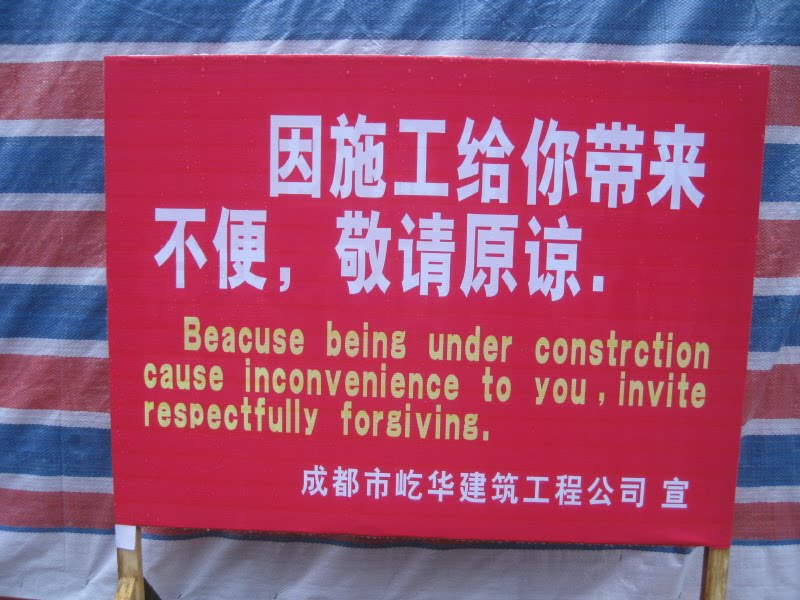 Example: "Beacuse (sic) being under constrction (sic) cause inconvenience to you, invite respectively forgiving." These are not handwritten signs but printed ones in Chinese and something like English at tourist destinations, like the Ghost City of the King of the Underworld in Feng Du. (See Monday Oct. 11 for info on the Ghost City)
In Suzhou we visited the home of an ancient government official Shi Zhengzhi: The Master-of-the-Nets Garden. A Chinese garden is not like a Western garden. To create a Chinese garden requires four elements: Water, rocks, a building, and flora, like trees.

This home built in 1140 AD was originally known as the Fisherman’s Retreat and laid out in the Southern Song Dynasty. It was renamed Master-of-the-Nets Garden in the reign of Quinlong (1711-1799) in the Qing Dynasty. To see more click on http://www.chinatourguide.com/suzhou/master_garden.html
It seems like I lost what happened on Friday, Oct.8 before we got on the boat for a cruise on the Yangtze River. Aren't you glad? Wow, this blog is getting too long.
 Saturday, Oct 9, The Three Gorges Dam: Wow, what an engineering marvel and a possible environmental catastrophe. This project is so massive (the dam is about 1 mile across) that you cannot get a photo of it unless you are in an airplane. So, I provided a photo of a model of the dam and the ship locks. You can read more about this amazing project at http://en.wikipedia.org/wiki/Three_Gorges_Dam
 Sunday, Oct 10. Tour on the Shennogxi tributary. We took a small Sampan up the stream, which is now more like a river after the Three Gorges Dam was built. It raised the water level by about 150 meters. During some parts of the year the stream would only be about 1-3 meter deep. To read more go to http://en.wikipedia.org/wiki/Shen_Nong_Stream
 Monday, Oct 11: My daughter’s birthday, Davida. Happy Birthday Sweetie. Tour of the Ghost City in Feng Du which became known as Ghost City in the Tang Dynasty (618-907) when two officials from the Imperial court married and settled on Mt. Minshan just outside the city. Their combined surnames, Yin and Wang, sound like King of Hell in Chinese. Read more at http://www.china-travel-tour-guide.com/attractions/fengdu-ghost-city.shtml
Tuesday, Oct 12. End of the tour in Chongqing. Saw the Pandas at the zoo. They are so cute and lazy. I saw a keeper and a Chinese tourist go into the habitat and put an apple in each paw of a Panda who was lying on his back. The Panda put the apples in his mouth and then looked around, still lying on his back, as if to say, "Are you going to give me some more?" I took a video of one eating bamboo that I will share later.
At 5 pm we arrived in Guilin. It has 4 features: 1. Hills, 2, clear water, 3. caves, and 4. spectacular rocks. It also has Osmanthus trees from which the flowers can be used for Osmanthus tea. We had some while we were there. Very good. Read more at http://en.wikipedia.org/wiki/Guilin
Wednesday, Oct 13: Guilin still, and a tour on the Li River: 4.5 hours. Just way too long for me, but the scenery was just what you'd expect to see in China based on the paintings and silk prints. We got to learn just how the tourists are ripped off after buying some objects in the bazaar in a city at the end of the river cruise in Yangshuo.

The photo of the carved wood shutters are similar to what Dianne thought she bought at a stall at the bazaar in Yangshuo, that did not get packed with the other items Dianne purchased.
Well that brings you up to date. It's 10 pm here in Guilin (population 30 million) and 7 am Wednesday at home in Los Angeles.
Note: After I got home I made a funny 1 ½ minute cartoon movie about my resistance to go to China. You can see it at http://www.xtranormal.com/watch/7442923/
Friday, April 16, 2010
Quasi Retirement
April 15, 2010
Big things have changed over the last couple of years: I retired from Gabriel Publications the end of 2007; closed my office in Sherman Oaks after 11 years; completed a swap of apartment buildings with my business partner through a real 1031 simultaneous exchange; and moved all my business operations to my home with my assistant. My work week is now down to about 35 hours and I just manage my apartment buildings. I get to sleep in to 7 am, ride my bike in the morning, play with my dogs and see my cat daily.
The office in Sherman Oaks was actually an apartment for my cat, Dogrun. He had to live there because my wife built is allergic to cats. Several years ago she built an art studio in the back yard for her daughter, and now Dogrun lives out there; no longer in my office over the lonely weekends.
Big things have changed over the last couple of years: I retired from Gabriel Publications the end of 2007; closed my office in Sherman Oaks after 11 years; completed a swap of apartment buildings with my business partner through a real 1031 simultaneous exchange; and moved all my business operations to my home with my assistant. My work week is now down to about 35 hours and I just manage my apartment buildings. I get to sleep in to 7 am, ride my bike in the morning, play with my dogs and see my cat daily.
The office in Sherman Oaks was actually an apartment for my cat, Dogrun. He had to live there because my wife built is allergic to cats. Several years ago she built an art studio in the back yard for her daughter, and now Dogrun lives out there; no longer in my office over the lonely weekends.
Wednesday, December 9, 2009
Parking Nightmare
The saga continues. My airfare from Burbank CA to Las Vegas NV was $46.53 plus taxes of $24.68. Total $71.20. When I arrived back two days later my motorcycle was soaking wet from the rain and it would not start and before I could leave, they wanted $80 in parking fees. You can read below the letter I sent to the Manager of Parking Operations for the Burbank Airport. I will post the results on my blog, but do not expect an entry any time soon.
Lot E Burbank Airport December 8, 2009
Entered 12-5-09 Exit 12-8-09
Total Fee Paid $80
Refund requested $80
Based on the information below, I am requesting a refund of my parking fee at the Burbank Airport:
1. Motorcycles used to park for free in the parking structure the last time I was at the Burbank Airport. I have a beautiful Honda Goldwing.
2. I was willing to pay the $20 daily fee, and then found out my motorcycle was prohibited from parking in the structure.
3. I parked where I was told in an open uncovered lot, and DID NOT take away a parking space for a car.
4. When I returned in the morning two days later it was raining. My motorcycle has NEVER before been parked out in the rain. It is always garaged.
5. I spoke to the airport security (Mr. Rickard) to find out what to do. He put me in touch with the parking department. I spoke to Lisa, then Patty, and finally got permission from Raymond Abara to park my bike in the structure until the next day when I could pick it up, hoping when it dried out it would start. If not, I would have to have it towed away. It took an additional 90 minutes before I could leave the airport and have my wife pick me up.
6. I had to push my 900 lb bike about 200 yards in the rain to get into the parking structure.
7. Again, I DID NOT take a parking space from a car but parked next to a storage container in the parking structure..
8. When I came back the next day my bike did start and now I was supposed to pay $80 instead of $40 when I was not my fault it was there another 30 hours.
9. I could have paid $30/day; taken a full parking place; been in the parking structure; returned to a dry motorcycle; and it would have only been $60. But I parked where I was told and now I am being asked to pay an additional $40 and never even took up a parking space. That is just completely unfair and obscene.
10. On the basis of the above 9 points I am requesting a full refund of $80. This fee is outrageous under the circumstances. My parking receipt is enclosed.
Rennie Gabriel, CLU, CFP, UCLA Instructor
Lot E Burbank Airport December 8, 2009
Entered 12-5-09 Exit 12-8-09
Total Fee Paid $80
Refund requested $80
Based on the information below, I am requesting a refund of my parking fee at the Burbank Airport:
1. Motorcycles used to park for free in the parking structure the last time I was at the Burbank Airport. I have a beautiful Honda Goldwing.
2. I was willing to pay the $20 daily fee, and then found out my motorcycle was prohibited from parking in the structure.
3. I parked where I was told in an open uncovered lot, and DID NOT take away a parking space for a car.
4. When I returned in the morning two days later it was raining. My motorcycle has NEVER before been parked out in the rain. It is always garaged.
5. I spoke to the airport security (Mr. Rickard) to find out what to do. He put me in touch with the parking department. I spoke to Lisa, then Patty, and finally got permission from Raymond Abara to park my bike in the structure until the next day when I could pick it up, hoping when it dried out it would start. If not, I would have to have it towed away. It took an additional 90 minutes before I could leave the airport and have my wife pick me up.
6. I had to push my 900 lb bike about 200 yards in the rain to get into the parking structure.
7. Again, I DID NOT take a parking space from a car but parked next to a storage container in the parking structure..
8. When I came back the next day my bike did start and now I was supposed to pay $80 instead of $40 when I was not my fault it was there another 30 hours.
9. I could have paid $30/day; taken a full parking place; been in the parking structure; returned to a dry motorcycle; and it would have only been $60. But I parked where I was told and now I am being asked to pay an additional $40 and never even took up a parking space. That is just completely unfair and obscene.
10. On the basis of the above 9 points I am requesting a full refund of $80. This fee is outrageous under the circumstances. My parking receipt is enclosed.
Rennie Gabriel, CLU, CFP, UCLA Instructor
Monday, December 7, 2009
F*$k'n air travel
This weekend it was so easy to be reminded why I am a resistant traveler. I think it has more to do with the airport security than anything else. I got a great ticket on Southwest at $50 round trip to
Well,
At least I had the foresight to print my boarding pass the day before so I wouldn't have to stand in line at the airport. But now I have to face the dreaded security checkpoints. I also plan ahead for this with my special "airport shoes." They are soft leather loafers, almost like slippers; easy off and easy on. I used to wear my regular hiking shoes until I learned the hassle of getting them on and off with the metal eyelets. Thanks to “Mr. Shoe Bomber" now no one can get on an airplane without first taking off their shoes. When they move to the full body cavity search I will no longer fly anywhere.
However, my shoes were not the problem. I first put my shoes and coat in a bin, and then put my hat upside down on the coat and placed my smart phone in the hat. Next I put my laptop in a separate tub just like I’m supposed to. Well, when the first tub started through the scanner it knocked my hat and cell phone into the tub with my laptop. OH, big no-no. The TSA employee said he had to re-screen the laptop because I did that. So, my computer goes to the back of the line and I’m waiting around for it to come through again.
While waiting I proceed to fill my pockets, put on my shoes, put on my coat and attempt to put on my fanny pack. For some reason the plastic piece will not snap into place, no matter how I line it up. I take a look at it and see the fanny pack I just purchased last month now has a broken buckle/snap. Oh great! Dianne makes fun of me because I wear it everywhere, but now I can’t wear it anywhere. I’ll have to carry it or tie the straps around me. I’ll look like some homeless person holding up his pants with a rope instead of a belt.
Finally I get my laptop back, tie on my fanny pack and head to my gate. While sitting there I glance to my right and notice a carry on suitcase like mine. It then dawns on me that I don’t have my carry on suitcase. Oh great! I hear the constant announcements over the PA system that any bag left unattended will be taken in by the police and blown up. I jump up and hurry back to the screening area.
As I arrive back to the baggage screening area and ask what to do if I left my suitcase here, she points me to a TSA officer who walks up to me with my suitcase and says, “I will have to screen your bag again because you left it unattended and I will have to do a hand search.”
The hand search reveals I didn’t put my itsy bitsy bottles of shampoo and conditioner in a quart sized clear plastic bag. I left them in my toiletries bag which has clear plastic pockets. AND I have this contraband size 6 oz toothpaste tube. I am for sure going to jail. But being a kindly TSA inspector, he says since I’ve already used half the tube, it’s probably only now 3 oz. BUT, he will have to screen my toothpaste tube separately to be sure it isn’t packed with chemical explosives.
Sure, I’m a 61 year old white male planning a trip to visit my grandchildren in
At this point you’d think the horror story stops; well it doesn’t. While on the way to the movies with my daughter Davida and grandsons, we get rear ended while waiting to get on the freeway. Auto accidents in
We get to the movies and I enjoyed “Planet 51.” We leave the movies, my daughter drops us off at home, and she continues on to Walgreens to pick up some items needed for the house. While tending my grandsons Davida calls me, “Dad, the car is stuck in ‘park’ and won’t go into ‘reverse’ or ‘drive’ or anything. What should I do?”
I reply, “I guess that smack in the rear end we got on the way to the movies must have done something to the transmission. See if you can reach your mother-in-law and have her bring you home. We’ll pick up the car tomorrow.”
The next day, Sunday, we head over to Walgreens and sure enough, no matter what we do, the car will not get out of ‘park.’ I get behind the car and try to move it forward while Davida tries to get it into gear. No luck. There is also a message on the dashboard that says something about needing to have the transmission serviced. I guess with a Volvo, if you are supposed to get service and don’t, they set the computer to block you from using the car.
I will leave out the details of what it’s like to spend two days with two boys ages 5 and 7, but I will say I am not planning a return visit any time soon. And I have video evidence to make my point.
Monday morning Davida takes me to the airport for the flight home. Things here seem to be going more smoothly. I remember to remove my all my belongings from the screening area and patiently wait to board my flight back to
Not only is the whole bike wet from the rain, but it appears water got into something and it won’t start. My Honda Goldwing spends its leisure time in the garage. My bike does not sit out in the rain. My bike does not have to travel in the rain. My bike doesn’t know about the rain. The battery is strong and it’s turning over just fine, but there is no spark, no ignition, no signs that the engine will roar to life. My bike is really angry at me that I left it out in the rain. I’ve never done this before and it’s getting back at me for this transgression.
Even though there are multiple signs that say, “Motorcycles Prohibited from Parking in the Structure” my only hope is to leave it somewhere safe until I can come back the next day. Then I can see if it will start after it dries out, or get it towed away. Knowing this is just as serious as a half tube of toothpaste, I go directly to the Airport Security office.
Officer Rickard tells me the thing to do is contact the parking division, which is separate from the security division and separate from the airport. He helps me find a courtesy phone; I dial 2 and speak with Lisa. I tell her my problem and she refers me to her supervisor Patty. I tell Patty my problem and she says she has to speak with the central parking manager. All I want to do is leave my bike in the parking structure without it being towed away.
The manager tells Patty, who tells me, that she will meet me in the parking structure and show me a place to put the bike. I let her know the bike weighs about 800 pounds and it’s not so easy to move, so I hope it’s not uphill.
Turns out I can park the bike very close to where I placed it in the parking structure. I wrote out a note explaining the situation in case the manager is not available and someone wants to tow it away. It has my name and phone number on the note. I have to be patient and see what tomorrow brings.
Rennie
Subscribe to:
Posts (Atom)

 Posts
Posts